The Reminiscence — The Monologues of Being Seen
The fourth edition of The Reminiscence: a three-month exhibition across three floors of the PCA&D gallery, bringing together photographs, performance, sculpture, and community testimony.
§ 01
About this edition
Dates
October 18 – December 2024
Venue
Pennsylvania College of Art & Design (PCA&D), Lancaster, PA
Related
Baldwin, Lee, & Henderson (2026), Visual Regimes of Discipline in U.S. Higher Education (opens in a new tab)
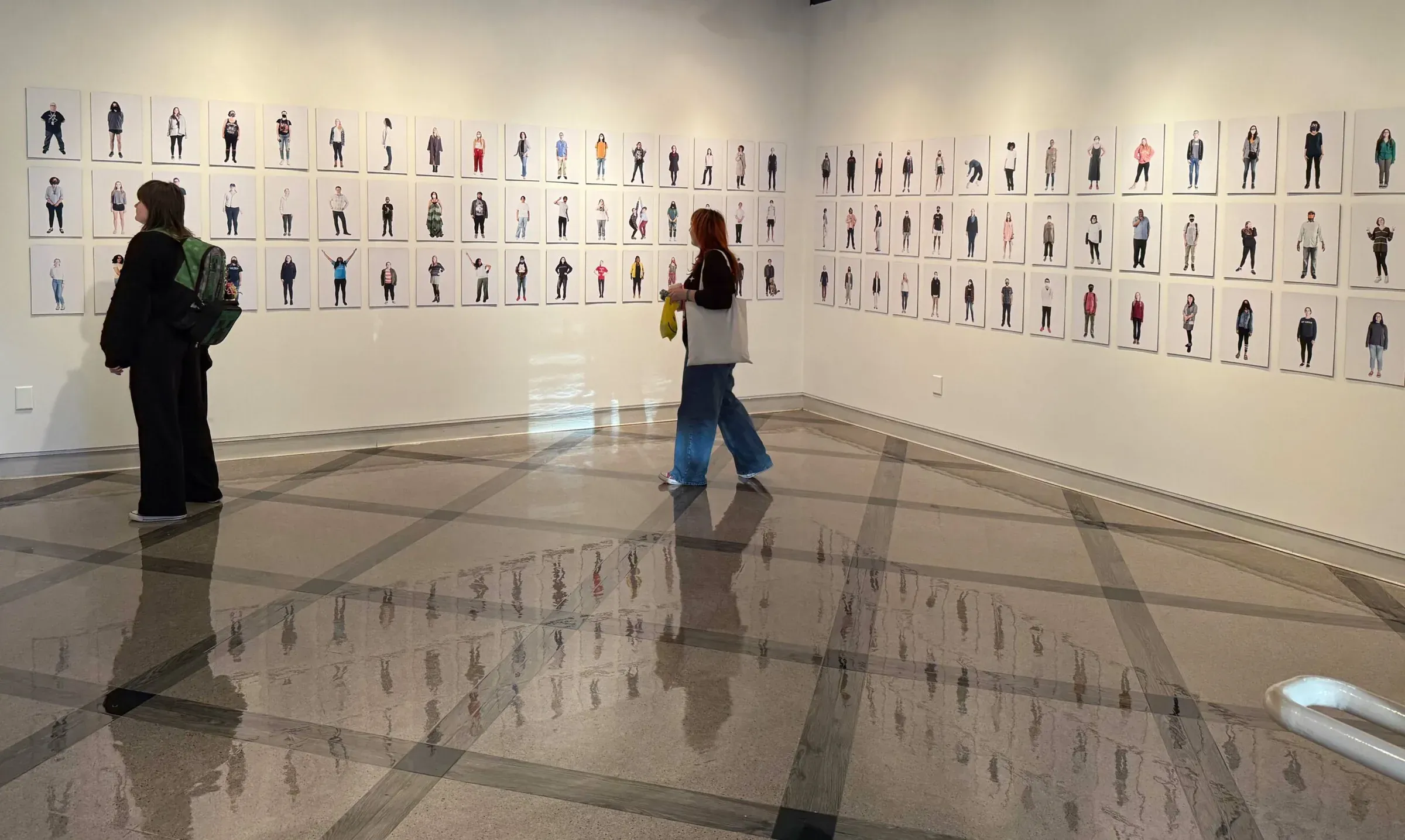
In fall 2024, The Reminiscence — The Monologues of Being Seen filled three floors of the main gallery at the Pennsylvania College of Art & Design (PCA&D) for three months. Each floor took a different form: posture photographs on the first, live performance and projection on the second, and the interactive sculptures and recorded monologues on the third. The design built on our installations at Connecticut College, Virginia Tech, and SIGGRAPH, and responded to PCA&D’s building and community.
The exhibition felt closer and more intimate than the Cube or the SIGGRAPH floor. One visitor told us, “My body became a mirror. I wasn’t just watching—I was remembering.” It also pointed us toward future work: longer performances, textile archives, and exchanges between communities.
Working with the community
PCA&D is an art micro-college with a significant population of neurodivergent and LGBTQ+ students. A campus-wide photography and 3D scanning initiative let students, faculty, and staff see themselves and their peers in a new light (Warshawsky et al., 2025).
We visited PCA&D in early 2024 to collect new data and work with the community. We asked participants, “When did you feel truly seen?” and shaped their answers into short monologues. Some spoke of the joy of unguarded acceptance, others of ambivalence about visibility itself, and others of identity as both a place of connection and of concealment. Together, they show how differently people experience being seen.
Our method is arts-based research that privileges lived experience and expressive form (Leavy, 2015). Performance, installation, and narrative are modes of inquiry in their own right (Taylor, 2003; Campt, 2017).
Research
Our critique of institutional visual regimes draws on critical race and feminist theory (Browne, 2015; Benjamin, 2019). It shows how legibility, surveillance, and aesthetic calibration have historically marginalized Black and Brown bodies.
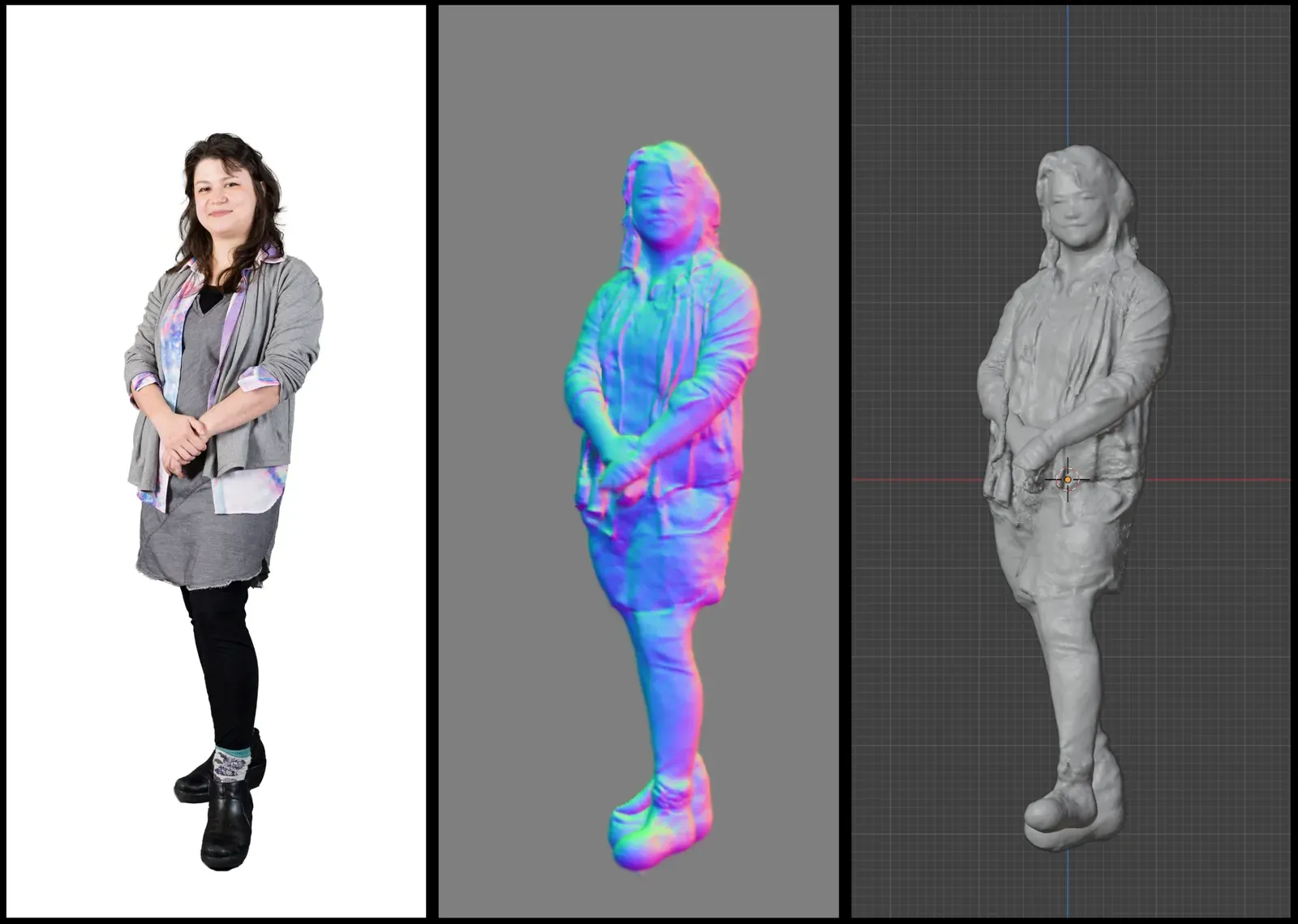
We met this history in our own tools. In Kinect-based 3D scanning, black clothing failed to reflect the infrared signal, which left partial or missing body data. Even contemporary imaging systems reproduce racialized invisibility (Browne, 2015).
§ 02
The installation
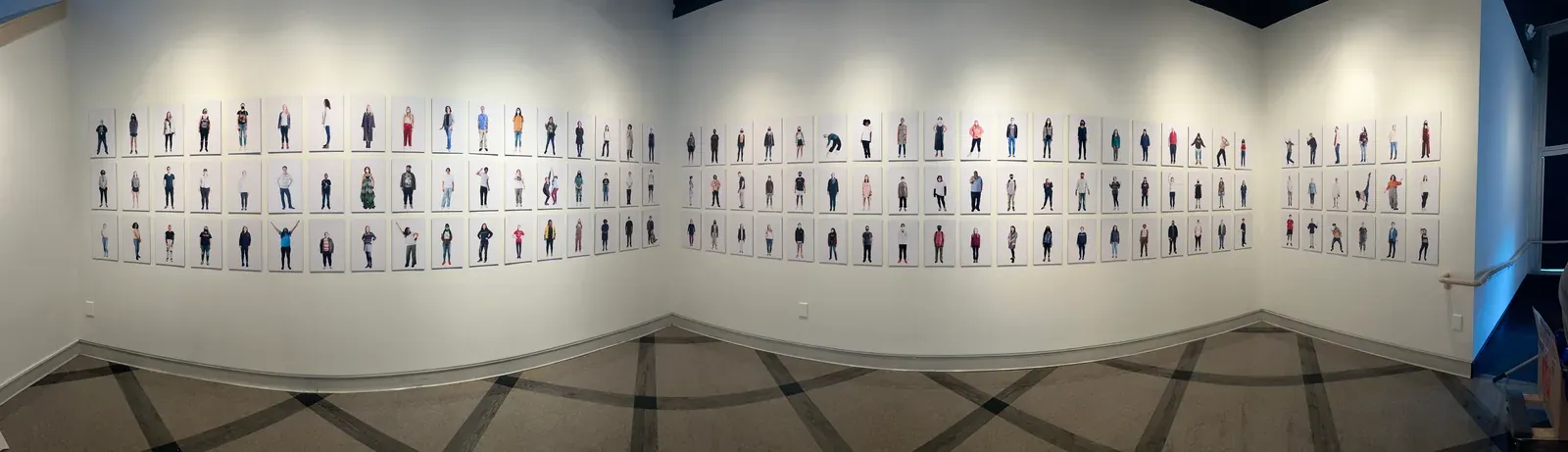
- First floor: the photographic archive. A montage of 126 posture portraits, including new contributions from PCA&D participants, covered three walls and could be seen by pedestrians outside the building. The photographs reflect agency and choice (Fleetwood, 2020).
- Second floor: performance and projection. Projection-mapped silhouettes of participants in motion, and the opening-night performance (see below).
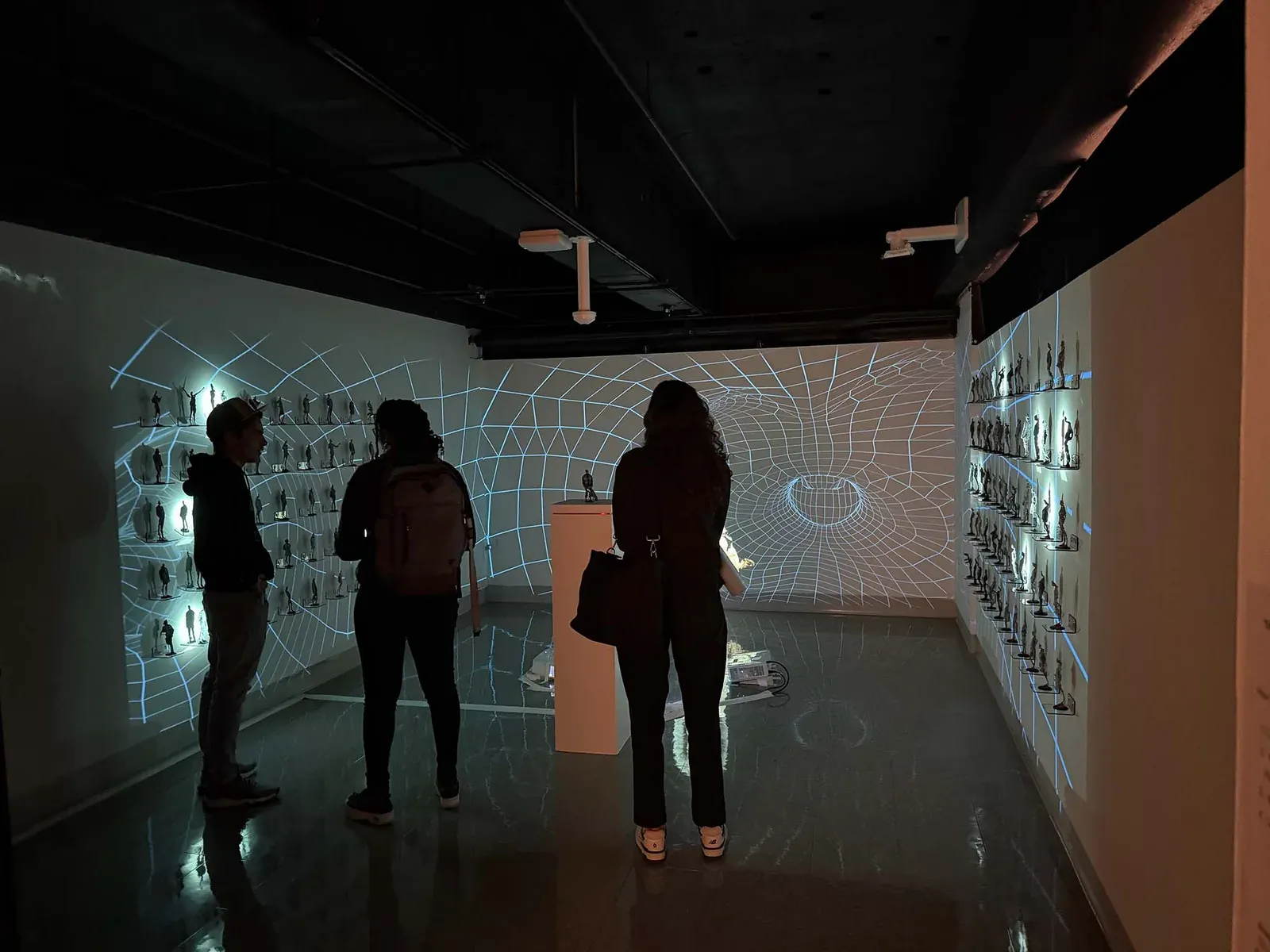
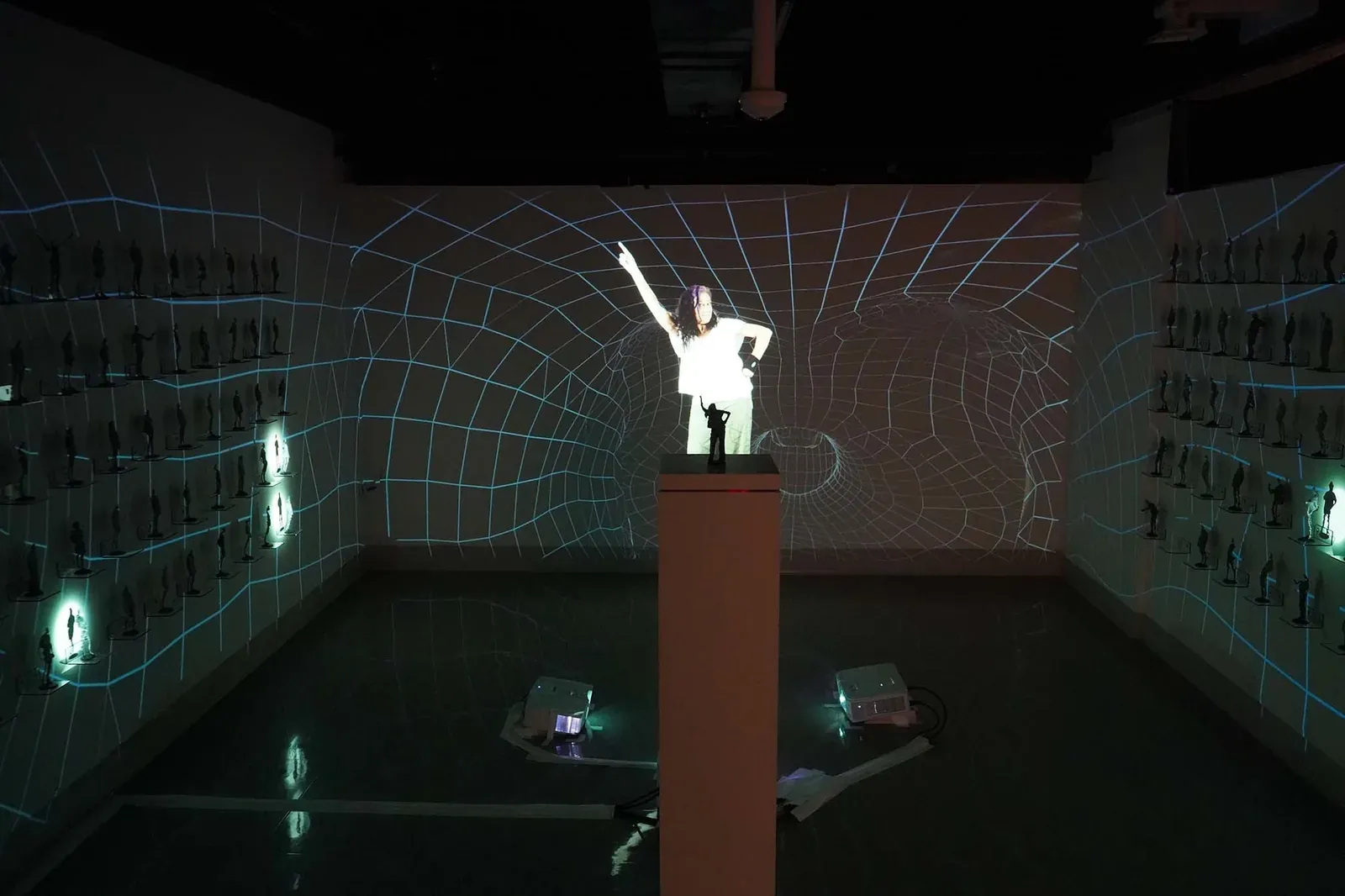
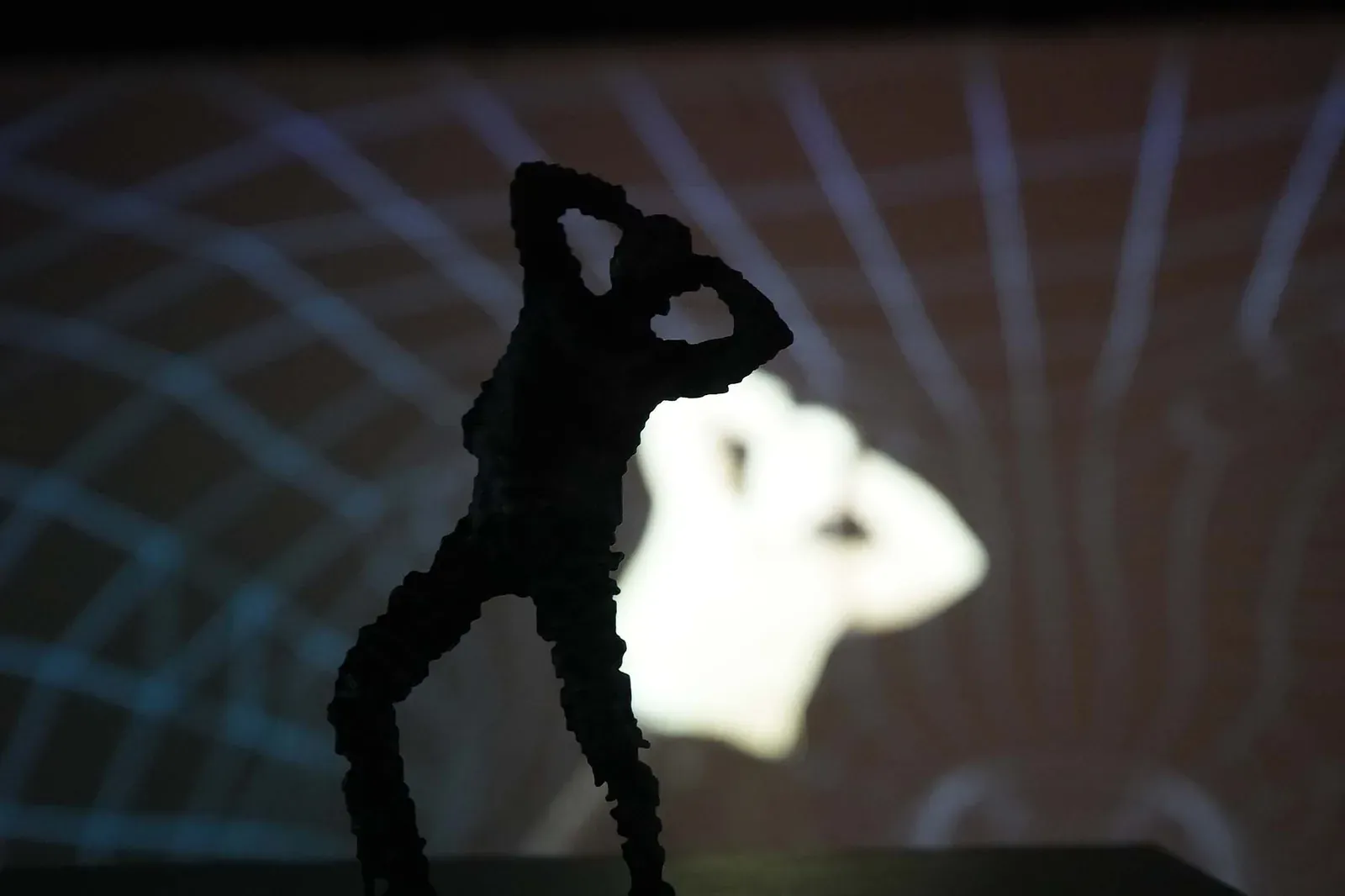
- Third floor: sculptures and monologues. 3D-printed sculptures of abstracted bodily forms, paired with monologues recorded by PCA&D participants. A visitor places a sculpture on the pedestal and hears a personal story of what it means to be seen, or unseen. Projected mesh visualizations slowly fade and reappear.
§ 03
Performance
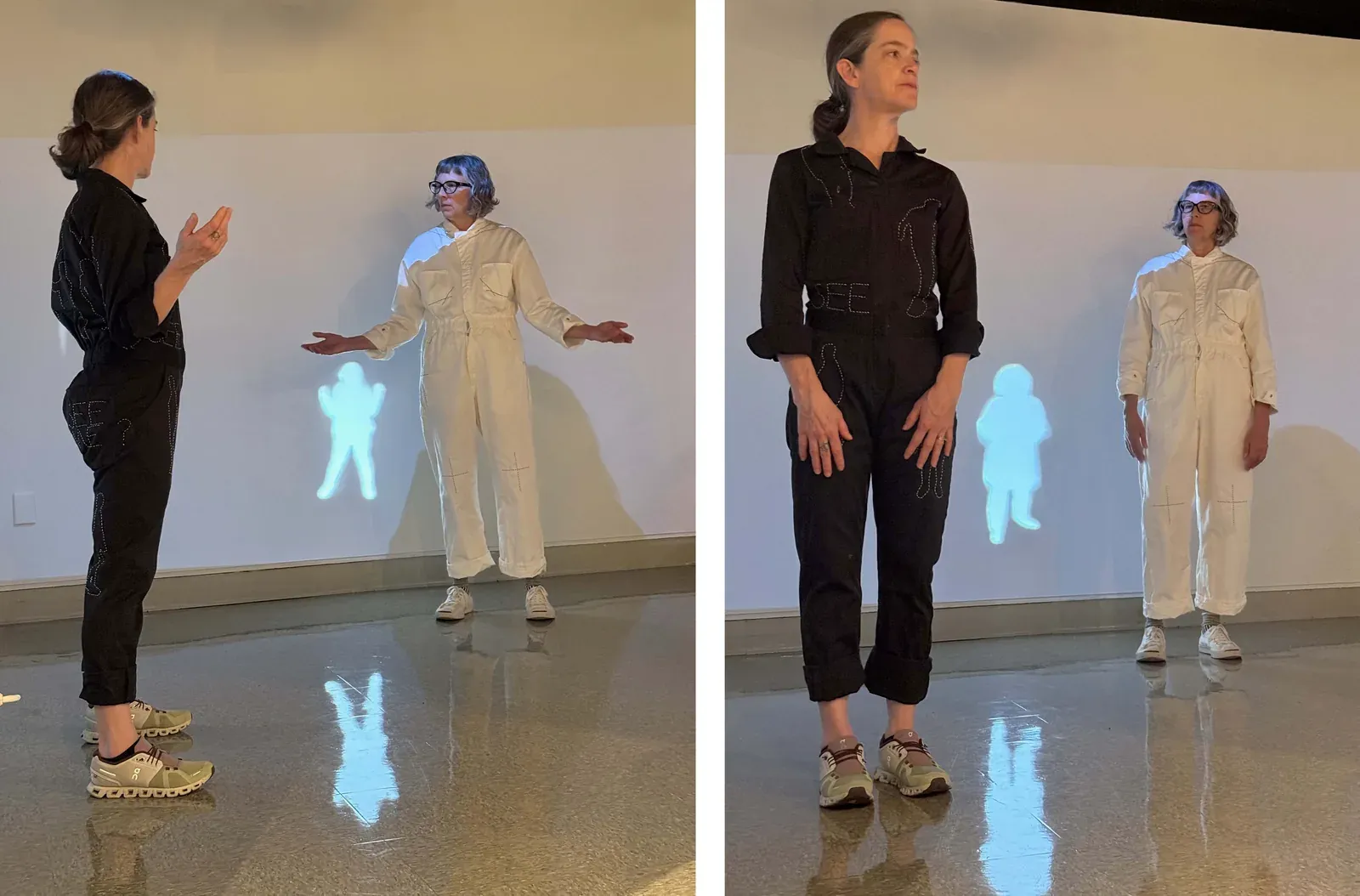
On opening night, Heidi Henderson and Pamela Vail, Professor of Dance at Franklin & Marshall College, performed an improvised postural duet on the second floor. Around them, projections from the ceiling onto three walls showed silhouettes of participants in motion, drawn from video taken during data collection: a slow-motion sequence with skipped frames that blurs and fades over time. These were gestures held just before the moment of performance, “the prelude to being seen.”
Henderson embroidered a jumpsuit for Vail that echoed the one she wore in 2018, threading ghostly traces of archival images into the fabric. Her own jumpsuit was stitched with the words “DO YOU SEE ME?” The garments became cloth as archive. The choreography recalled Blondell Cummings’s practice of layering gesture, memory, and domesticity into movement (Willis, 2021).
Quieter and more tactile than the Cube, the duet relied on proximity and improvised response. In Henderson’s words, “the two moving bodies became linked to each other and to the many past participants.” Both dancers are white women. Rather than reenact the experiences of racialized dancers, the duet asked them to inhabit the historical frame reflectively, and to make visible how whiteness has served as the unmarked standard in dance and visual culture.
§ 04
How it works
The third-floor platforms are RFID-triggered: placing a sculpture on the pedestal plays the matching participant’s monologue. This floor reused the 2022 setup and added 27 new data sets and sculptures from the PCA&D community.
Because black clothing defeated the Kinect’s infrared scanning, we used machine learning to reconstruct the missing body geometry from monocular video (Guo et al., 2023). We then abstracted these shapes again into the sculptural forms. Other recent methods, such as HumanNeRF and PersonNeRF, may also help with this problem (Weng et al., 2022, 2023).
§ 05
Gallery
§ 06
Credits
- Collaborators
- Andrea N. Baldwin
- Heidi Henderson
- Sangyoon Lee
- Performers
- Heidi Henderson
- Pamela Vail
- Support
- An anonymous donor
- Nations Photo Lab
- Thanks
- Natasha Warshawsky, PCA&D, our point person for the exhibition
- The PCA&D participants, who contributed new portraits and monologues
- Photography
- Sangyoon Lee
- Andrea N. Baldwin
- PCA&D
§ 07
References
- Benjamin, R. (2019). Race after technology: Abolitionist tools for the New Jim Code. Polity.
- Browne, S. (2015). Dark matters: On the surveillance of Blackness. Duke University Press.
- Campt, T. (2017). Listening to images. Duke University Press.
- Fleetwood, N. R. (2020). Marking time: Art in the age of mass incarceration. Harvard University Press.
- Guo, C., Jiang, T., Chen, X., Song, J., & Hilliges, O. (2023). Vid2Avatar: 3D avatar reconstruction from videos in the wild via self-supervised scene decomposition. In Proceedings of the IEEE/CVF Conference on Computer Vision and Pattern Recognition (CVPR) (pp. 12858–12868). IEEE.
- Leavy, P. (2015). Method meets art: Arts-based research practice (2nd ed.). Guilford Press.
- Taylor, D. (2003). The archive and the repertoire: Performing cultural memory in the Americas. Duke University Press.
- Warshawsky, N., Baldwin, A. N., Henderson, H., & Lee, S. (2025, June 24). Monologues of Being Seen: Process and impact [Panel presentation]. Association of Academic Museums and Galleries (AAMG) Annual Conference, Albuquerque, NM, United States.
- Weng, C.-Y., Curless, B., Srinivasan, P. P., Barron, J. T., & Kemelmacher-Shlizerman, I. (2022). HumanNeRF: Free-viewpoint rendering of moving people from monocular video. In Proceedings of the IEEE/CVF Conference on Computer Vision and Pattern Recognition (CVPR) (pp. 16210–16220). IEEE.
- Weng, C.-Y., Srinivasan, P. P., Curless, B., & Kemelmacher-Shlizerman, I. (2023). PersonNeRF: Personalized reconstruction from photo collections. In Proceedings of the IEEE/CVF Conference on Computer Vision and Pattern Recognition (CVPR) (pp. 6105–6115). IEEE.
- Willis, T. A. (2021). One body, one memory: Performance, presence, and embodied archive in Marjani Forté-Saunders’s Memoirs of a... Unicorn. In M. Gaines (Ed.), Black performance on the outskirts of the left: A history of the impossible (pp. 51–70). NYU Press.